early in the story, July 31
Harry's Birthday at Privet Drive
Harry Potter, now thirteen, spends his birthday night secretly doing homework under his blankets at Number Four, Privet Drive. He receives his first-ever birthday cards and presents from his friends Ron Weasley and Hermione Granger, as well as from Hagrid, who sends a biting book. The arrival of the Hogwarts letter includes a permission form for Hogsmeade visits, which Harry knows his aunt and uncle will never sign. This event establishes Harry's difficult home life and his longing for the wizarding world.
early in the story, a week after Harry's birthday
Aunt Marge's Visit
Uncle Vernon's sister, Aunt Marge, arrives for a week-long stay. She is a large, overbearing woman who delights in criticizing Harry and comparing him unfavorably to Dudley. The Dursleys force Harry to pretend he attends St. Brutus's Secure Center for Incurably Criminal Boys. Harry endures her insults, but when she slanders his parents, he loses control and accidentally inflates her like a balloon. Fearing punishment, he flees the house with his trunk and Hedwig's cage.
immediately after inflating Aunt Marge, late at night
The Knight Bus
After running away from Privet Drive, Harry finds himself stranded in the dark Muggle world. He sees a large black dog in the shadows, then flags down the Knight Bus, a magical triple-decker purple bus for stranded witches and wizards. The conductor, Stan Shunpike, and driver, Ernie Prang, take him to London. During the journey, Harry learns about Sirius Black, a notorious mass murderer who has escaped from Azkaban prison. The bus drops him at the Leaky Cauldron, where he is met by Cornelius Fudge, the Minister of Magic.
early morning after the Knight Bus ride
Meeting with Cornelius Fudge
Cornelius Fudge, the Minister of Magic, meets Harry at the Leaky Cauldron. To Harry's surprise, Fudge is not angry about the incident with Aunt Marge; instead, he is relieved to find Harry safe. Fudge explains that the Accidental Magic Reversal Department has already handled the situation. He allows Harry to stay at the Leaky Cauldron for the remainder of the summer but insists he remain in Diagon Alley. Harry asks Fudge to sign his Hogsmeade permission form, but Fudge refuses, citing rules. Harry senses something odd about Fudge's leniency.
the following two weeks
Summer in Diagon Alley
Harry enjoys a newfound freedom in Diagon Alley, exploring shops, eating ice cream, and completing his homework with help from Florean Fortescue. He visits Gringotts to refill his money bag and is tempted by the magnificent Firebolt broom in Quality Quidditch Supplies. He buys his new schoolbooks, including the aggressive Monster Book of Monsters for Care of Magical Creatures. He also notices a book about death omens featuring a black dog, which unsettles him. Finally, Ron and Hermione arrive, and they spend time together before the start of term.
the day before term starts
The Weasleys at the Leaky Cauldron
The entire Weasley family arrives at the Leaky Cauldron. Harry meets Mr. and Mrs. Weasley, Fred, George, Percy, and Ginny. During dinner, Harry overhears Mr. and Mrs. Weasley arguing about Sirius Black. Mr. Weasley reveals that Black escaped Azkaban to kill Harry, as he was Voldemort's right-hand man and believes murdering Harry will bring Voldemort back to power. Harry learns that Dementors are guarding the school. He feels a mix of fear and determination, but is also disappointed that his chances of visiting Hogsmeade are now zero.
September 1
Departure for Hogwarts
The Ministry of Magic provides cars to take the Weasleys, Harry, and Hermione to King's Cross Station. Mr. Weasley pulls Harry aside and warns him not to go looking for Sirius Black. Harry boards the Hogwarts Express with Ron and Hermione. They find an empty compartment occupied by a sleeping man, who they later learn is Professor R. J. Lupin, the new Defense Against the Dark Arts teacher. The journey is uneventful until the train makes an unexpected stop.
during the train journey to Hogwarts
Dementor Attack on the Hogwarts Express
The Hogwarts Express stops suddenly and the lights go out. A Dementor, a hooded creature that feeds on happiness, enters Harry's compartment. Harry is overwhelmed by the cold and hears his mother's dying screams. He passes out. Professor Lupin drives the Dementor away with a silvery charm and gives Harry chocolate to revive him. Harry is embarrassed and confused by his reaction, as no one else fainted. This event marks Harry's first encounter with a Dementor and reveals his deep trauma.
evening of September 1
Arrival at Hogwarts
The students arrive at Hogsmeade station and take carriages to Hogwarts. Harry sees two more Dementors guarding the gates. In the Entrance Hall, Professor McGonagall calls Harry and Hermione to her office, where Madam Pomfrey checks on Harry. They then join the feast in the Great Hall. Dumbledore announces that Dementors are stationed at every entrance and warns students not to leave school without permission. He also introduces two new teachers: Professor Lupin for Defense Against the Dark Arts and Rubeus Hagrid for Care of Magical Creatures. Harry, Ron, and Hermione are thrilled for Hagrid.
the first day of classes
First Divination Lesson
Harry, Ron, and Hermione attend their first Divination class with Professor Trelawney in her tower room. The lesson involves reading tea leaves. Professor Trelawney examines Harry's cup and dramatically announces that he has the Grim, a spectral dog that is an omen of death. This disturbs Harry, especially since he has already seen a large black dog twice. Hermione is skeptical, but Ron is deeply worried. The class leaves Harry feeling uneasy.
the first day of classes
First Care of Magical Creatures Lesson
Hagrid's first Care of Magical Creatures lesson introduces the class to Hippogriffs. He explains that they are proud creatures and must be approached with respect. Harry successfully bows to Buckbeak and is allowed to ride him, flying around the paddock. Draco Malfoy, however, insults Buckbeak and is slashed on the arm. Malfoy exaggerates his injury, and Hagrid is devastated, fearing he will be fired. Harry, Ron, and Hermione vow to support Hagrid.
early in the school year
The Boggart Lesson
Professor Lupin's first Defense Against the Dark Arts lesson is a practical one on Boggarts, shape-shifting creatures that take the form of a person's worst fear. Neville Longbottom faces the Boggart, which turns into Professor Snape. With Lupin's guidance, Neville transforms it into a comical version of Snape in his grandmother's clothes. The class takes turns, but when it is Harry's turn, Lupin steps in and stops him. Later, Lupin explains he thought the Boggart would become Voldemort, but Harry admits he feared the Dementors. The lesson is a great success and makes Lupin popular.
Halloween night
Sirius Black's Break-in
After the Halloween feast, the Gryffindors return to their common room to find the Fat Lady's portrait slashed. Sirius Black has attempted to break into Gryffindor Tower. The students are forced to sleep in the Great Hall while the castle is searched. Harry overhears Dumbledore and Snape discussing Black's escape and Dumbledore's refusal to let Dementors inside the castle. The event heightens the sense of danger and leads to increased security, including the replacement of the Fat Lady with the erratic Sir Cadogan.
early November
Gryffindor vs Hufflepuff Quidditch Match
The first Quidditch match of the season is Gryffindor versus Hufflepuff. The weather is terrible, with heavy rain and strong winds. During the match, Harry sees a large black dog in the stands, which distracts him. Then, a hundred Dementors appear on the field, and Harry hears his mother's screams again. He falls from his broom, losing the match for Gryffindor. He wakes in the hospital wing to find his Nimbus Two Thousand has been destroyed by the Whomping Willow. Harry is devastated by the loss and the humiliation.
the weekend of the second Hogsmeade trip
The Marauder's Map
Fred and George Weasley give Harry the Marauder's Map, a magical parchment that shows the entire Hogwarts castle and grounds, including the location of every person and secret passages. Using the map, Harry discovers a hidden passage that leads to Honeydukes in Hogsmeade. He uses it to sneak into the village, where he meets Ron and Hermione. They visit the Three Broomsticks, where they overhear a conversation between the teachers and Cornelius Fudge, revealing that Sirius Black was the Potters' Secret-Keeper and betrayed them to Voldemort. Harry is shocked and furious.
Christmas morning
The Firebolt Arrives
Harry receives an anonymous Christmas gift: a Firebolt, the fastest and most advanced broomstick in the world. He is overjoyed, but Hermione is suspicious, fearing it might be jinxed by Sirius Black. She reports her concerns to Professor McGonagall, who confiscates the broom for testing. Harry and Ron are furious with Hermione, leading to a rift in their friendship. The Firebolt is eventually returned after extensive checks, proving to be safe. The incident strains Harry's relationship with Hermione.
after Christmas
Anti-Dementor Lessons Begin
Professor Lupin begins teaching Harry the Patronus Charm to defend against Dementors. The lessons take place in the History of Magic classroom using a Boggart disguised as a Dementor. Harry struggles at first, unable to produce a strong Patronus because his happy memories are not powerful enough. He also hears his parents' voices during the attempts. Over several sessions, he manages to produce a silvery, indistinct Patronus, but it is not yet strong enough to drive a Dementor away. Lupin encourages him, saying it is a significant achievement for his age.
early spring
Gryffindor vs Ravenclaw Quidditch Match
The Gryffindor versus Ravenclaw Quidditch match is crucial for the Quidditch Cup. During the game, three figures disguised as Dementors appear, but Harry, now more confident, successfully casts a powerful Patronus. The figures are revealed to be Draco Malfoy, Crabbe, Goyle, and Marcus Flint, who were trying to sabotage him. They are caught and punished. Harry catches the Snitch, securing Gryffindor's victory. The match boosts Harry's confidence and his ability to fight the Dementors.
the night after the Ravenclaw match
Sirius Black's Second Break-in
Ron wakes to find Sirius Black standing over him with a knife in their dormitory. Black slashes Ron's bed curtains but flees when Ron screams. The castle is searched again, but Black escapes. It is discovered that Neville Longbottom had written down the passwords and lost them, allowing Black to enter. Neville is punished severely. The incident causes widespread fear and leads to even tighter security, including the hiring of security trolls to guard the Gryffindor common room.
spring
Buckbeak's Appeal Fails
Hagrid loses the appeal for Buckbeak's life. The Committee for the Disposal of Dangerous Creatures has sentenced the Hippogriff to be executed at sunset. Hagrid is devastated. Harry, Ron, and Hermione visit him to offer support. They discover that Scabbers, Ron's pet rat, is hiding in Hagrid's cabin. The execution party, including Cornelius Fudge and the executioner Walden Macnair, arrives. Harry, Ron, and Hermione are forced to leave, but they are determined to help.
the evening of Buckbeak's execution
The Shrieking Shack Confrontation
Harry, Ron, and Hermione follow Scabbers and Crookshanks into a tunnel under the Whomping Willow, which leads to the Shrieking Shack. There, they find Ron and Sirius Black, who is actually an Animagus in the form of a dog. Black reveals that Scabbers is Peter Pettigrew, another Animagus, who faked his death and framed Black for betraying the Potters. Professor Lupin arrives and confirms the story. The truth about the Potters' betrayal is finally uncovered.
during the Shrieking Shack confrontation
Peter Pettigrew Transforms Back
Lupin and Black force Scabbers to transform back into human form. Peter Pettigrew, a short, balding man with a rat-like appearance, appears. He confesses to betraying Lily and James Potter to Voldemort and framing Sirius Black. He begs for mercy, but Black and Lupin prepare to kill him. Harry intervenes, convincing them to hand Pettigrew over to the Dementors instead. Pettigrew is bound, but during the journey back to the castle, he escapes when Lupin transforms into a werewolf under the full moon.
the night of the Shrieking Shack
The Dementor's Kiss Averted
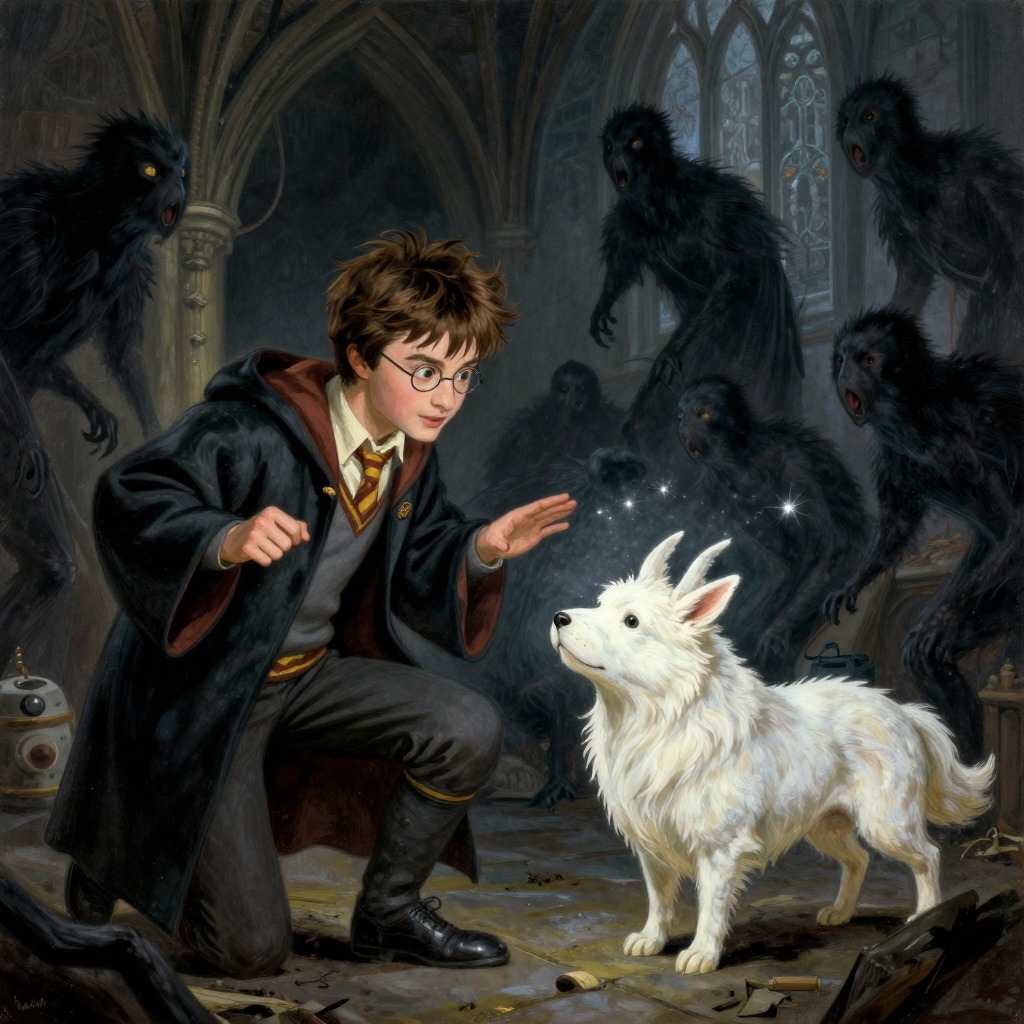
After Pettigrew's escape, Harry, Hermione, and the unconscious Sirius are surrounded by Dementors. Harry tries to conjure a Patronus but fails. Just as a Dementor is about to administer the Dementor's Kiss to Harry, a powerful silver stag Patronus appears and drives the Dementors away. Harry sees a figure on the opposite bank of the lake and believes it is his father. He later realizes that he himself conjured the Patronus, as he had seen himself doing it earlier in the time loop.
the night of the Shrieking Shack
Harry and Hermione Use the Time-Turner
Dumbledore reveals that Sirius is to be given the Dementor's Kiss. He hints that Harry and Hermione can use Hermione's Time-Turner to go back in time. They travel back three hours and witness their past selves. They free Buckbeak and hide in the forest. When the execution party arrives, they see Buckbeak has vanished. Later, they fly Buckbeak to the tower where Sirius is imprisoned and rescue him. Sirius escapes on Buckbeak, clearing his name in the process.
the day after the Shrieking Shack
Lupin's Resignation
Professor Lupin resigns from his post after Snape reveals to the school that he is a werewolf. Harry tries to convince him to stay, but Lupin feels he cannot risk another incident. He gives Harry back the Marauder's Map and the Invisibility Cloak. Harry is saddened by his departure, as Lupin was the best Defense Against the Dark Arts teacher they had. Dumbledore comforts Harry, telling him that his father lives on in him.
the end of the school year, on the Hogwarts Express
Sirius's Letter
On the train back to London, a tiny owl delivers a letter from Sirius Black. Sirius explains that he sent the Firebolt and apologizes for frightening Harry. He encloses a signed Hogsmeade permission form for Harry. He also gives Ron the tiny owl as a replacement for Scabbers. Harry is overjoyed and feels a sense of hope for the future. He returns to the Dursleys with a lighter heart, knowing he has a godfather who cares for him.